Crisis on Infinite Earths #1 Canada: The Issue That Changed DC Forever
Crisis on Infinite Earths #1 Canada collectors are holding one of the most historically significant single issues in DC Comics history — the opening chapter of the twelve-part maxi-series that fundamentally restructured the DC universe in 1985 and established the template for every universe-wide crossover event that followed it.
Published in April 1985, Crisis on Infinite Earths was DC’s answer to decades of accumulated continuity complexity. Multiple Earths, conflicting histories, and characters whose origins had been revised and contradicted across forty years of publishing had made DC’s universe genuinely difficult for new readers to navigate. Editor Marv Wolfman and artist George Pérez were tasked with the most ambitious editorial project in DC’s history — streamlining the entire DC multiverse into a single cohesive continuity through a story that would kill characters, collapse realities, and permanently alter the publishing landscape.
Issue #1 is where that story begins — and it begins with multiple first appearances that give the book a key issue density rare even by DC’s standards.
A Canadian Price Variant: Why This Specific Copy Matters More
One of the most significant details about this particular copy of Crisis on Infinite Earths #1 Canada is the variant type noted on the listing — Canadian Price Variant.
Canadian Price Variants (CPVs) are among the most actively discussed and increasingly valued segments of the Copper Age collector market. Here is why they matter:
During the late 1970s through the late 1980s, Marvel and DC distributed comics into the Canadian market with a separate cover price printed on the cover — reflecting the currency differential between the US and Canadian dollar at the time. This copy carries a 95¢ Canadian price versus the standard 75¢ US price visible on the cover.
Because Canadian Price Variants were printed in smaller quantities than their US counterparts — distributed only to the Canadian market — they represent a genuinely scarcer version of any given issue. The print differential between US and Canadian distribution for this era is significant, and high grade CPVs are considerably harder to find than their US equivalents.
For a landmark key issue like Crisis on Infinite Earths #1, the CPV designation elevates an already significant book into a more specific and scarcer collector tier. A 9.2 graded CPV with exceptionally white pages is not a common find — it represents the intersection of scarcity, condition, and historical significance that serious collectors actively pursue.
Crisis on Infinite Earths #1 Canada: Multiple First Appearances in One Issue
What makes Crisis on Infinite Earths #1 Canada particularly compelling as a key issue is the density of first appearances contained within a single issue:
- First appearance of Blue Beetle (Ted Kord) in the DCU — Ted Kord’s Blue Beetle had previously existed at Charlton Comics before DC acquired the character. His appearance here marks his first integration into the main DC universe — a distinction that matters considerably for Blue Beetle collectors given the character’s growing media profile
- First appearance of Pariah — a character central to the Crisis narrative whose role in DC’s ongoing continuity has extended across decades of publishing
- First appearance of Alex Luthor Jr. — the son of the heroic Lex Luthor of Earth-3, a character whose significance extends well beyond this series into later DC storylines
- First full appearance of the Monitor — the cosmic entity whose existence frames the entire Crisis narrative
- Harbinger’s origin — Lyla Michaels becomes Harbinger in this issue, establishing another character whose DC history runs deep
Five distinct character milestones in a single issue is exceptional by any standard. Each one independently provides a reason for a collector to seek out this book — together they make it one of the most key-issue-dense single comics DC published in the Copper Age.
Why Crisis on Infinite Earths Is Relevant Again in 2025
For collectors tracking Crisis on Infinite Earths #1 Canada, the timing of renewed interest in this series is directly tied to what is happening at DC right now.
James Gunn’s DC Studios reboot — the DC Universe initiative — is undertaking exactly the kind of continuity consolidation that Crisis on Infinite Earths pioneered in 1985. The decision to build a new cohesive DC cinematic universe from scratch, retiring previous iterations of characters and establishing new canonical versions, is structurally identical to what Wolfman and Pérez did on the page forty years ago.
That parallel has not been lost on collectors or on the broader comics press. As DC’s theatrical and streaming output builds toward its new continuity, the original template for how a publisher resets its universe has returned to active collector conversation. Blue Beetle in particular — who received his own theatrical film in 2023 — connects this issue directly to DC’s current media output in a way that provides an ongoing demand driver beyond pure historical significance.
Exceptionally White Pages on a 1985 Book: What That Means
The grader’s note on this copy reads exceptionally white pages — a detail that deserves specific attention for collectors evaluating a 1985 Copper Age book.
Paper quality deterioration is one of the primary condition concerns for comics from this era. The newsprint and mid-grade paper stocks used in the early-to-mid 1980s are susceptible to tanning, browning, and brittleness when exposed to humidity, heat, or UV light over time. A book from 1985 with exceptionally white pages — forty years after publication — represents a storage and preservation history that is genuinely uncommon.
In the graded comic market, page quality is assessed alongside the numeric grade and noted on the label. The distinction between white, off-white, and cream/tan pages on a Copper Age book can affect both the perceived condition and the market reception of a copy. Exceptionally white pages on a 9.2 from 1985 tells a story of exceptional care — and that story is part of what this copy offers.
The Significance of George Pérez's Art on This Series
No discussion of Crisis on Infinite Earths #1 Canada is complete without acknowledging the artistic achievement that George Pérez brought to the series.
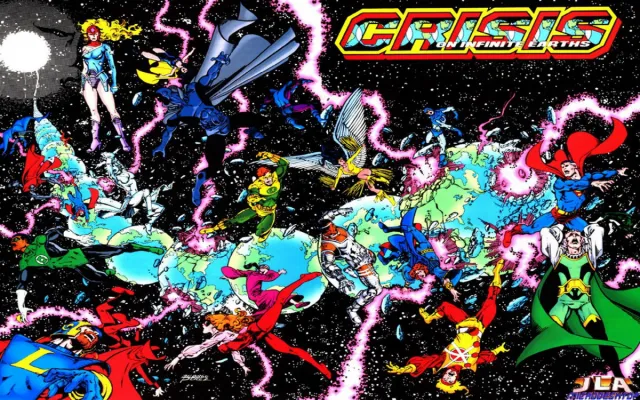
Pérez was tasked with illustrating a story that required him to render hundreds of DC characters simultaneously — the iconic cover of issue #1 alone features dozens of heroes and villains positioned against a cosmic backdrop with a compositional complexity that few artists could manage. His ability to maintain visual clarity while populating pages with vast numbers of characters at a level of detail that rewarded close reading is widely regarded as one of the most impressive artistic achievements in mainstream comics history.
Pérez passed away in 2022, and his death renewed collector and critical attention to his body of work. For a book he considered among his career-defining achievements, that renewed attention has translated into sustained collector engagement with the Crisis series — and issue #1 as the opening chapter carries the full weight of that legacy.
What to Look For in a Raw Copy
For collectors evaluating a raw copy of Crisis on Infinite Earths #1, the Copper Age paper stock and the book’s distinctive cover present specific condition markers:
- Cover colour integrity — The cover features a complex, highly saturated colour scheme. Fading, stress lines, or colour breaking along the spine are the first things to assess
- Spine condition — A book of this size and page count is susceptible to spine roll. Look carefully for stress lines particularly on the upper and lower spine
- Staple condition — Both staples should be tight, flat, and rust-free. Copper Age books stored in humid conditions can develop staple rust relatively quickly
- Interior page quality — As noted above, page tanning is the primary concern on 1985 books. White to off-white pages indicate exceptional storage history
- Canadian price stamp visibility — On CPV copies, the Canadian price should be cleanly printed and fully legible. The variant designation is part of the book’s identity and condition
The Issue That Established the Template
What makes Crisis on Infinite Earths #1 Canada genuinely singular in the DC Copper Age key issue market is that its significance operates on multiple levels simultaneously — historical landmark, multiple first appearances, Canadian Price Variant scarcity, exceptional condition story, and renewed cultural relevance tied to DC’s current publishing and cinematic direction.
Each of those elements would independently justify collector attention. Together they make this a book whose place in the DC collector canon is not dependent on any single factor — and that kind of multi-layered significance is exactly what serious long-term collectors look for in a key issue acquisition.
Invest Comics Canada currently has a 9.2 raw copy of Crisis on Infinite Earths #1 — Canadian Price Variant with exceptionally white pages — in stock.
Check Out Our Shop
Browse rare graded comics, key issues, and curated collections designed for long-term value.